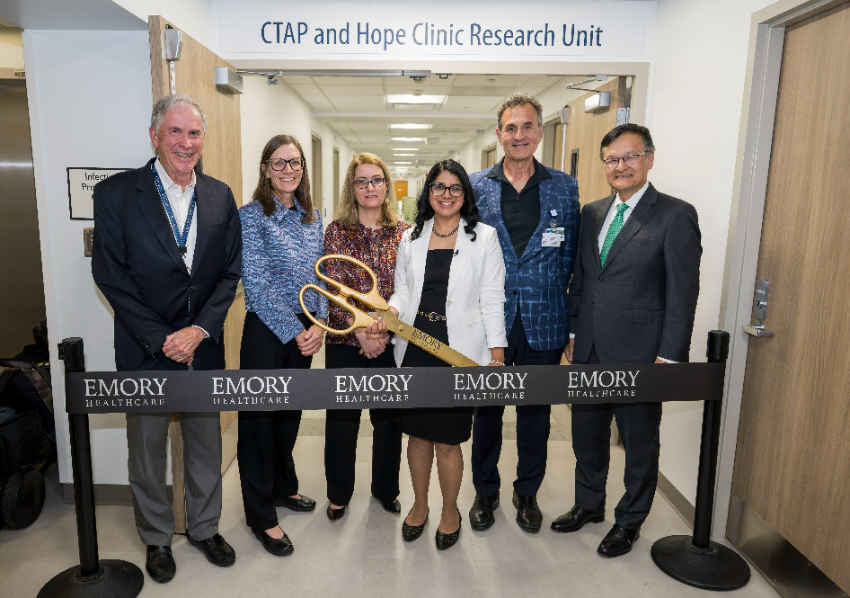
Supported by a $10 million philanthropic investment from Flu Lab, an organization founded to advance innovative approaches for the prevention and treatment of influenza, this new space seamlessly integrates clinical care and research to directly measure how viruses spread through the air.
As national leaders in infectious disease research and care, the Emory Center for Transmission of Airborne Pathogens unit marks a significant milestone in advancing controlled human infection studies and transmission science. The custom-designed unit features a 10-bed human challenge unit where study participants volunteer to enroll in human infection transmission studies involving airborne infectious diseases, including influenza, RSV, and other viruses. The unit also contains two dedicated exposure rooms with temperature and humidity controls, a clean room for aerosol sampling and an on-site virology laboratory.
“This specialized unit has unique environmental systems to allow precise control of temperature and humidity—critical factors that influence airborne transmission—but have historically been difficult to study in human settings,” says Seema Lakdawala, PhD, co-director of the Emory Center for Transmission of Airborne Pathogens and associate professor in the Department of Microbiology and Immunology, Emory University School of Medicine. “By combining these capabilities, the unit enables researchers to capture concrete data on how infectious viruses are transmitted human-to-human and develop practical interventions to reduce the spread of respiratory pathogens and make indoor spaces safer.”