May is National Speech-Language-Hearing Month. The annual observance is to raise awareness about communication disorders and to honor those who provide treatment.
Physicians at Emory Healthcare perform both traditional and robotic-assisted cochlear implant surgeries to mitigate hearing loss that affects communication disorders. Emory Healthcare leads the state as the first and only healthcare system in Georgia to offer advanced robotic-assisted surgeries, having completed more than 30 surgeries thus far.
“I was working in construction and around loud machinery. I could hear, but it was like my ear was hurting or something,” says Poole.
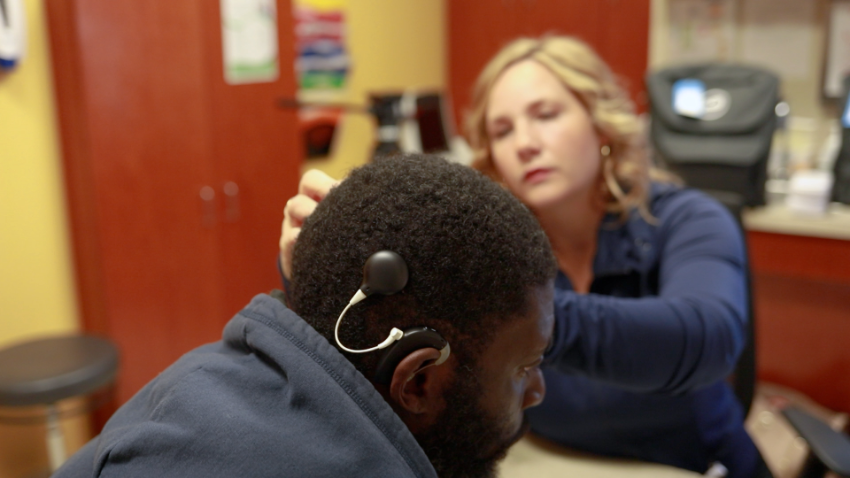
Kelley Dwyer, AuD, is chief of audiology with Emory Healthcare and Poole’s doctor.
“When we first met him, he was not really able to communicate by listening,” says Dwyer. “He could read lips and would write to communicate.
Dwyer says progressive hearing loss in both ears like Poole’s could be genetic or his sudden loss could be caused by viral or environmental factors. On Poole’s 40th birthday, he had surgery for cochlear implants, which are implanted electronic devices.“A cochlear implant is a way for a person to hear that is not hearing. The way that we hear is there's a sound pressure wave that goes down the ear canal, hits the eardrum, moves the fluid in the cochlea, which is our hearing organ and sends that sound up to the brain,” says Dwyer.
She goes on to explain when there is severe hearing loss, a cochlear implant can mimic that process by sending an electric signal to the brain with a receiver and a transmitter.
“What happens is there's an outside piece with the microphone that picks up sound and sends it to the inside," says Dwyer. "We get it to the inside by a magnet and that signal is picked up by the antenna.”
Recently, Dwyer activated Poole’s cochlear implants and they are both grateful for the outcome.
“It’s like a microphone, you can hear it good,” says Poole. “I can hear everything around here and it’s overwhelmed my heart rate.”
Now, this father and husband can experience the sounds he misses most.
“I can enjoy my kids’ voices, you know maybe want to hear my wife’s voice every now and then,” says Poole with a laugh.“It’s a beautiful experience to actually hear sound. It’s hard to find the words and I’m still rejoicing.”